

1.0 Introduction: The Critical Choice in Agentic AI Development
The rapid evolution of artificial intelligence has led to a proliferation of powerful new tools, particularly in the realm of agentic AI. With a surge of innovative frameworks released in late 2023 and early 2024, developers and organizations now face a pivotal decision. The choice of an agentic framework is not merely a technical detail; it is a foundational architectural commitment that profoundly impacts long-term maintainability, scalability, and the ultimate success of an AI application. Selecting the wrong framework can introduce significant technical debt and the risk of architectural lock-in, while the right choice can accelerate progress and unlock new capabilities.
This whitepaper provides a clear, authoritative guide to three of the most prominent open-source agentic frameworks available today: Microsoft’s AutoGen, LangChain’s LangGraph, and CrewAI, which is backed by deeplearning.ai and Andrew Ng. Each is supported by a major organization in the AI space and offers a distinct approach to building multi-agent systems.
The objective of this analysis is to equip professionals with a comprehensive understanding of each framework’s core philosophy, capabilities, and limitations. By evaluating these tools across practical project requirements—from learning curve and design flexibility to scalability and ecosystem support—this document will enable you to make an informed and strategic selection for your specific use case.
2.0 Core Architectural Philosophies
Before comparing specific features, it is crucial to understand the fundamental design philosophy that underpins each framework. This core architecture dictates a framework’s inherent strengths, its limitations, and the types of problems it is best suited to solve. Understanding these foundational differences is the first step toward aligning a framework with your project’s goals.
AutoGen: The Actor-Based Model
AutoGen is architected around the actor framework, a well-established model for asynchronous, distributed software systems. In this paradigm, agents are treated as independent “actors” with access to a set of tools. These actors communicate by sending and receiving messages within designated “chats.” An entire agentic process is orchestrated as a conversation that continues among these actors until a specific termination condition is met, signaling that the task is complete to a satisfactory standard.
LangGraph: The Graph-Based State Machine
LangGraph is a more generic and lower-level framework, drawing its architectural inspiration from systems like Pregel and Apache Beam. Its core concept is the construction of applications as directed graphs, composed of nodes (computational units) and edges (the paths between them). This approach, similar to the popular NetworkX library in Python, provides developers with complete control over the application’s workflow. Rather than prescribing a specific agentic concept like a “crew” or “chat,” LangGraph provides the fundamental building blocks to implement any agentic architecture.
CrewAI: The Task-Based Crew Abstraction
CrewAI operates at a higher level of abstraction, centered on the intuitive concept of a “crew.” A crew consists of multiple agents, each defined with a specific role and a set of tools (e.g., a “software developer” or a “copywriter”). The crew is assigned a series of “tasks” to complete, and it executes them according to a chosen “process,” which can be either sequential or parallel. This model is particularly well-suited for problems that can be clearly decomposed into a series of distinct tasks. For ease of configuration, agents and tasks can be defined in simple YAML files.
These philosophies represent three distinct approaches to agentic design: AutoGen’s conversational, emergent behavior; CrewAI’s structured, process-driven execution; and LangGraph’s unopinionated, foundational toolkit for bespoke system construction. This fundamental difference is the primary driver of their respective strengths and weaknesses, which will be explored in the detailed comparison that follows.
3.0 Deep Dive: A Comparative Analysis of Core Capabilities
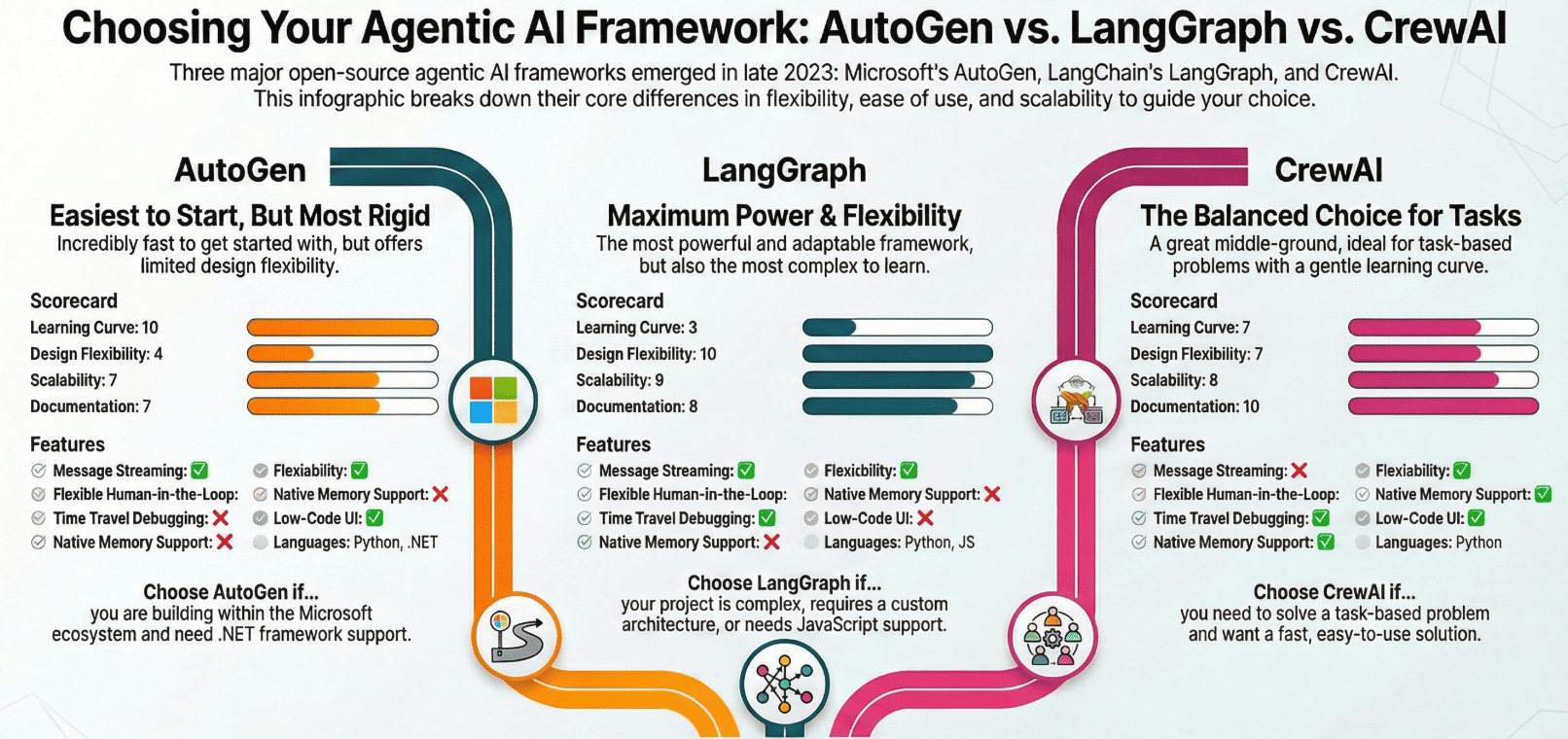
A framework’s utility is not absolute but is defined by its performance against key architectural non-functional requirements. The following analysis evaluates the three frameworks across four critical vectors: learning curve, design flexibility, scalability, and ecosystem integration. This comparison uses ratings from the source material to ground the evaluation, offering a clear and objective look at how these frameworks stack up against one another in practice.
3.1 Ease of Use & Learning Curve
A framework’s learning curve directly impacts project velocity and team onboarding costs. A simpler framework allows for faster prototyping, while a more complex one may require a greater initial investment for long-term gains.
- AutoGen (10/10): This framework has a “very fast” learning curve. Its core concepts are simple and intuitive—agents and chats. A developer can get started with as few as six lines of code, and the business logic does not become significantly more complex as the system grows.
- CrewAI (7/10): Positioned between the simplicity of AutoGen and the complexity of LangGraph, CrewAI is still quick to get started with. While it introduces more concepts to learn (agents, tools, processes, tasks), its quick-start guide is short, allowing developers to become productive rapidly.
- LangGraph (3/10): The learning curve for LangGraph is “quite steep.” This difficulty stems not from poor documentation but from its conceptual nature. As a generic framework, it requires the developer to first understand and choose the specific agentic architecture they wish to implement, making it inherently more challenging to grasp initially.
3.2 Design Flexibility & Architectural Freedom
The ability to customize and control the agentic workflow is essential for building sophisticated and unique AI applications that can evolve over time.
- LangGraph (10/10): As a true framework, LangGraph offers “complete freedom” and is the most flexible of the three. Its graph-based structure allows a developer to implement virtually any architecture, including replicating the behavior of AutoGen or CrewAI. This power, however, comes at the cost of requiring more code to implement.
- CrewAI (7/10): CrewAI offers greater flexibility than AutoGen. Its primary strength lies in solving problems that can be neatly decomposed into a task-based structure. However, this focus also represents its main limitation; it can become difficult to use for use cases that do not fit this model, such as building dynamic conversational agents.
- AutoGen (4/10): The framework’s design flexibility is “quite limiting” for language model applications. While the underlying actor framework is powerful for traditional software, it makes it difficult to modularize agentic systems and systematically improve their performance. AutoGen explicitly sacrifices flexibility for ease of use.
3.3 Scalability & Production Readiness
A framework’s ability to perform reliably under load and be deployed in a distributed environment is paramount for production-grade applications.
- LangGraph (9/10): LangGraph is highly scalable. Its foundation on architectures like Pregel and Apache Beam, coupled with full asynchronous support, makes it well-suited for serverless deployments. Its design flexibility also aids scalability by allowing developers to create reusable, testable units that can be combined to build complex, reliable systems.
- CrewAI (8/10): This framework supports asynchronous execution, a key requirement for scalability. While its built-in memory feature uses a local SQLite database, which could pose a scaling challenge, it allows for the use of external providers like Mem0. Its level of abstraction provides a more scalable foundation than AutoGen.
- AutoGen (7/10): AutoGen is built on the asynchronous actor model and supports async messaging. However, confidence in its current stable version is tempered by the announcement of a new version (0.4) intended to improve its event-driven architecture, implying potential issues or limitations with the existing implementation.
3.4 Ecosystem & Integrations
A rich ecosystem of integrations for LLMs, tools, and monitoring services is crucial for building robust, real-world applications and avoiding vendor lock-in.
- LangGraph (8/10): Because each node in a LangGraph graph is simply code, it can technically integrate with any library or service available in Python or JavaScript. It has full, native integration with the broader LangChain ecosystem and the LangSmith observability platform for monitoring.
- CrewAI (8/10): CrewAI integrates directly with LangChain for tools, giving it access to a vast library. It also supports multiple monitoring frameworks, including the open-source option OpenLIT. Notably, it can even orchestrate a LangGraph agent as part of its crew, demonstrating strong interoperability.
- AutoGen (6/10): Integration with non-OpenAI models requires users to set up a local proxy server to force other models into an OpenAI-compatible format. From an architectural standpoint, this approach introduces an additional point of failure and operational overhead, contrasting with the native, multi-provider support in other frameworks. It has strong integrations with Microsoft products but is less ideal for other cloud environments. For monitoring, it has a partnership with Agent Ops.
This deep dive reveals a clear trade-off between the frameworks, which can be further clarified by examining a direct comparison of specific operational features.
4.0 Feature Matrix: A Head-to-Head Comparison
This section provides a consolidated, at-a-glance comparison of key operational features across the three frameworks. This matrix is designed for quick reference to help assess which framework’s technical capabilities align most closely with specific project requirements.
| Feature | AutoGen | LangGraph | CrewAI |
| Streaming | Yes (input & output), but complex to set up. | Yes, first-class support for messages or tokens. | No support. |
| Human in the Loop | Yes, but highly constrained (never, always, or at termination). | Yes, highly flexible support at any point in the execution. | Yes, but limited (only at the end of a task). |
| Time Travel | No support. | Yes, supported. | Yes, supported. |
| Built-in Memory | No mention of built-in support. | No mention of built-in support. | Yes, built-in support for short/long-term and user memory. |
| Low-Code Interface | Yes, AutoGen Studio (open source). |
Yes, LangGraph Studio, but it is an IDE, not a true low-code tool. |
Yes, an unofficial CrewAI Studio exists. |
| Language Support | Python and C#/.NET | Python and JavaScript | Python only |
With this data synthesized, we can now formulate clear, actionable recommendations for common development scenarios.
5.0 Use Case-Driven Recommendations
While the analysis shows that no single framework is universally “best,” a clear choice emerges when evaluated against specific project goals and constraints. This section provides explicit recommendations based on common development scenarios, synthesizing the findings from the comparative analysis.
For Rapid Prototyping and Defined, Task-Based Problems
Recommendation: CrewAI
CrewAI is the ideal choice for projects where the problem can be clearly broken down into a series of tasks for a team of agents. Its fast learning curve, high-level abstractions, and ease of use make it perfect for rapid prototyping. Strong integrations and built-in memory support further accelerate development, allowing teams to build and test functional multi-agent systems quickly.
For Complex Workflows, Conversational Agents, and Maximum Control
Recommendation: LangGraph
LangGraph is the architecturally sound choice for systems where long-term flexibility and control are paramount. For applications requiring complex, non-linear workflows or real-time interaction, its complete design freedom allows developers to build any system they can envision. Its first-class support for streaming is a critical feature for conversational and voice-based AI. Furthermore, its support for JavaScript opens it up to a wider range of development ecosystems. This power comes with a steeper learning curve, making it best for teams that need ultimate control and are willing to make the initial investment.
For Integration with Microsoft and .NET Ecosystems
Recommendation: AutoGen
For development teams heavily invested in the Microsoft technology stack, AutoGen becomes the mandatory choice. It is the only framework among the three that offers official support for the C#/.NET framework. This unique language support, combined with its strong integrations with other Microsoft products, makes it the logical selection to maintain architectural consistency and leverage existing institutional knowledge within the Microsoft stack.
Final Thoughts
The selection of an agentic AI framework is a pivotal decision that shapes the trajectory of an AI project. This analysis has demonstrated that the optimal choice is not universal but is highly dependent on the specific use case, existing technology stack, and the development team’s priorities. AutoGen, LangGraph, and CrewAI each present a compelling but distinct value proposition.
The central theme that emerges from this comparison is a fundamental trade-off between abstraction and control. Frameworks like CrewAI and AutoGen offer higher levels of abstraction, enabling rapid development and ease of use, particularly for well-defined, task-oriented problems. In contrast, a lower-level framework like LangGraph provides unparalleled power, control, and flexibility, making it the superior choice for complex, bespoke systems at the cost of a steeper initial learning curve. By understanding this trade-off and aligning it with project requirements, organizations can confidently select the framework that will best serve their strategic goals and drive the successful deployment of their next generation of agentic AI applications.